23/01280/PIP | Erection of house | Land 160M NE Of Wester Farigaig Foyers
Please find on this page planning matters pertinent to our local area of Farigaig and Boleskine.
Related applications:
Reference 23/01280/PIP | Erection of house | Land 160M NE Of Wester Farigaig Foyers
Contents
Misrepresentation of Information
Material Considerations for Planning
What the proposals mean for local residents
What the proposals mean for residents in the greater Loch Ness area
What the proposals mean for everyone else internationally
Background
Highland Council Planning Portal: 23/01280/PIP | Erection of house | Land 160M NE Of Wester Farigaig Foyers
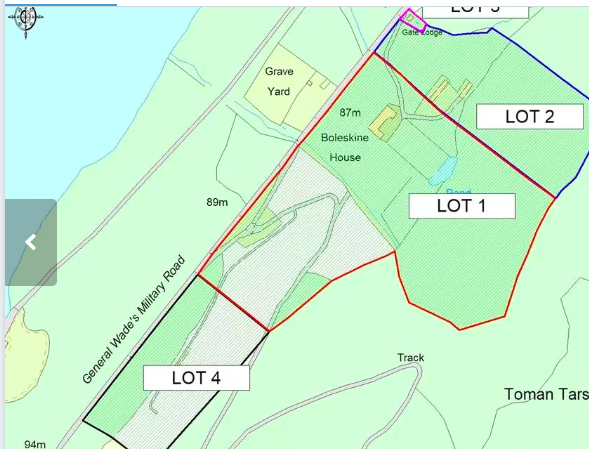
There is currently a planning proposal for a large single dwelling on retained lands at Boleskine, submitted as Planning in Principle Reference 23/01280/PIP to The Highland Council Planning Authority. The application is now available for public viewing and consultation on the Highland Council Planning portal on the link above. The proposal has been lodged by Colin Armstrong Architects. The owners of the development are the former land owners of Boleskine House who retained lands during the 2019 sale, called “Lot 4.”. Below our immediate residents and community of Stratherrick, greater community of Loch Ness, and visitors to the region from all around the world will find important information regarding this application.
This application appears to be a revised set of plans originally submitted under 22/05975/PIP and since withdrawn, presumably because of the substantial amounts of representations objecting to the application. While this application has revised the plans to include a single dwelling instead of six dwellings, the material conditions under 22/05975/PIP are still very much valid and outlined below.
Historical Precedents for Planning
It is important to first note that, like the point raised in 22/05975/PIP, there are historical precendents for refusal of permanent housing on this land. Find below four previous applications—References 1992/1157–1160 for four separate dwellings in 1992.
As can be seen from the above documents, The Highland Council refused planning permission for the erection of permanent dwellings for a number of reasons. Although the applications were submitted in 1992, many of the reasons for refusal are still valid today and pertinent for the concerns for residents and businesses within the Farigaig and Boleskine area and greater Stratherrick region, mainly:
- Visual Impact: A cluster of houses on the most elevated and exposed area, especially within an area of outstanding natural beauty and within close proximity to tourist amenities and local businesses, will have a significant negative impact, being out of character for the immediate region.
- Granting permission for a permanent housing estate on such a plot of land would set a new precedent for further development of the same sort in the future.
- Granting permission for such a development is contrary to The Highland Council’s policies on safeguarding the natural environment and heritage amenities.
More recently, data uncovered through a Freedom of Information request has revealed that the Highland Council found this site unsuitable for residential development as recent as June 2020. Noteworthy in the case of this application, the Council was skeptical of an acceptable access to the site, remarking that there were inadequate visibility splays and that any modification of this would disturb the character of the area (i.e., cutting back vegetation and altering the historic wall along the B852).
Placemaking
The recently drafted Inner Moray Firth Proposed Local Devlelopment Plan 2 has suggested new “Placemaking” strategies for future developments, identifying areas like Foyers as “growing settlements,” of which more development for housing would be supported. While it is not clear in this document where the Council places the boundary of the growing settlement, recent discussions between the Farigaig and Boleskine Residents and the coordinators of the Draft Local Place Plans for the Foyers and Stratherrick Community Action Plan have outlined the need for conservation for the area. There are hopes to establish the immediate area with enhancing bio-diversity initiatives and a desire to maintain the build and natural heritage of the area with no further development.
It is our opinion that the Farigaig and Boleskine corridor lie outside this boundary and is characterised by the Wider countryside. Evidence of this can be found in a 2014 planning applicaition that was refused on nearby land called Sealladh An Loch. The Delegated Report for this application (13/04146/PIP) refused the plans for multiple dwellings for similar reasons outlined above, that a cluster of homes in the Wider countryside was not in keeping with the area. You can find a copy of this Delegated Report below. See particularly clause 8.3.
Misrepresentation of Information
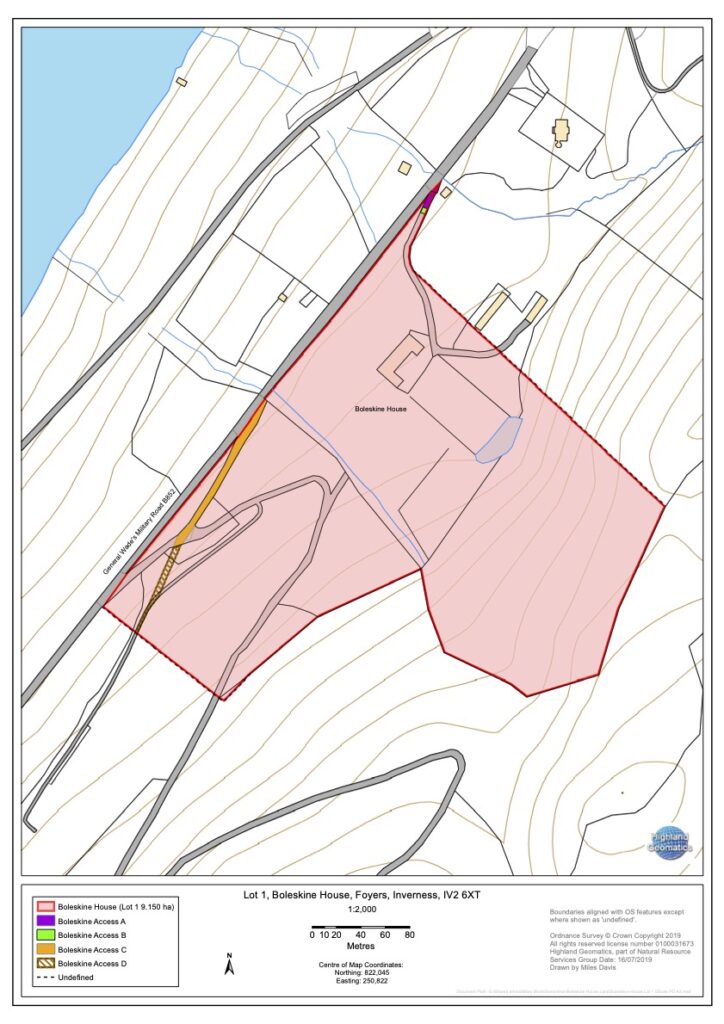
It is important to understand that misrepresentations over access to the site persist in this application as they did in 22/05975/PIP. Mainly, the applicant has incorrectly represented an access arrangement that exists consented under a previous application 20/02471/FUL, which they do not have entire legal rights of access over.
It should be noted that the architect has been made aware of these errors by neighbouring land owners, and has willingly not changed them.
Material Planning Considerations
We have listed below a number of material planning considerations about the proposals, referencing the appropriate policies outlined in the Highland-wide Local Development Plan (HwLDP). It is important that local residents become well-aquainted with them so that our community knows how these will likely affect all who live locally.
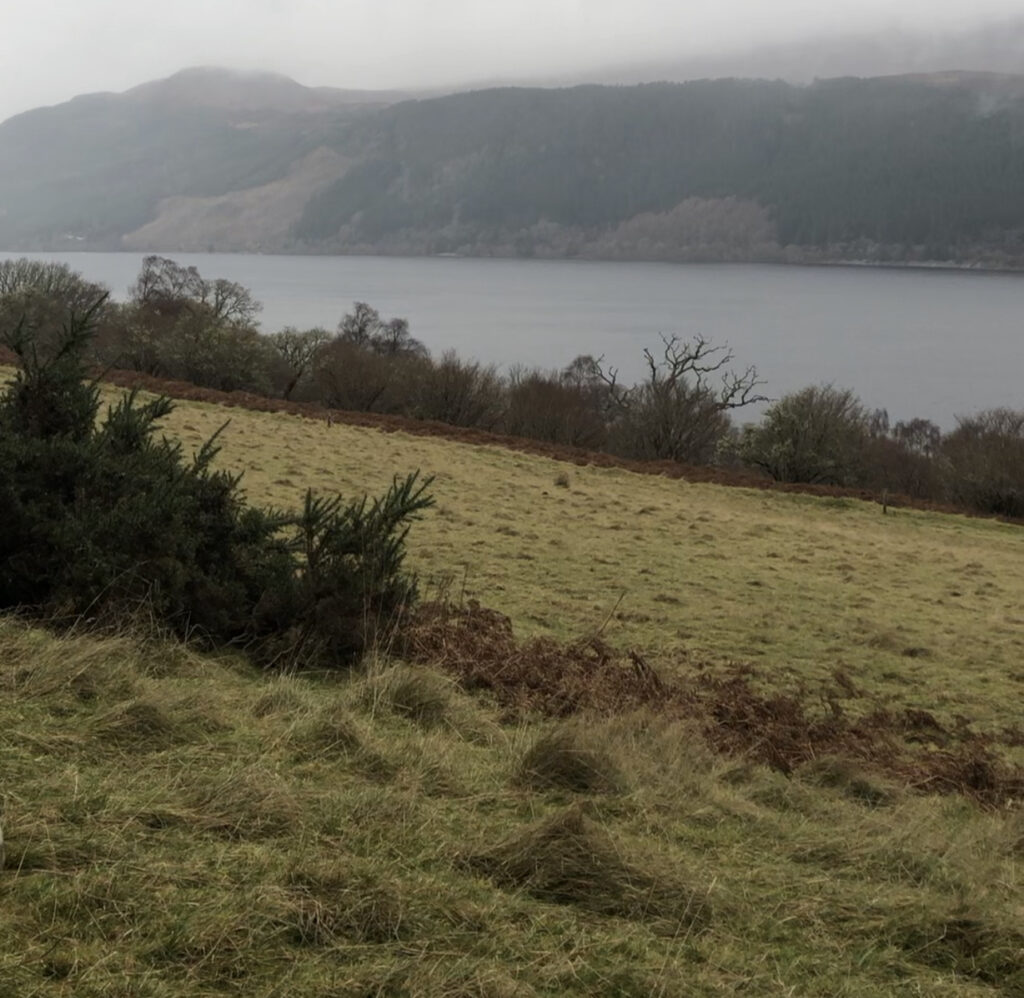
- Design (Policy 28, Policy 36, Policy 43): The overall design does not sit within the landscape in a suitable or sustainable way. The proposed materials are not in keeping with the Boleskine estate, which consists of granite and sandstone construction. The visual impact of such a large house on a wide open and exposed space cannot be underestimated. Being on one of the most elevated, open, and undisturbed areas of undeveloped land next to an ancient forest, this development will be seen from Loch Ness and the opposite side of Loch Ness very clearly.
- Impact on Tourism and Tourist Amenities (Policy 43): Tourism and recreation has not been considered in this application. The proposed development has the potential to impact tourists along the east side of the Loch Ness route (B852) during the construction phase due to increased work traffic and wide loads required to carry the equipment for six properties to the site. Moreover, the proposed development has the potential to impact this beyond construction due to landscape and visual impacts as outlined above under ‘Design.’
- Impact on Trees (Policy 51): The site and its access are within and next to an ancient mature woodland. Policy 51 states that The Highland Council will only support development which promotes protection of hedges, trees and woodlands around development sites. There is no evidence of thorough tree surveys being undertaken to investigate the impact of protected trees and roots throughout and after construction and along the access route, including the faciliation of water services which exist behind the land and within the Farigaig forest owned by the Foresty Commission.
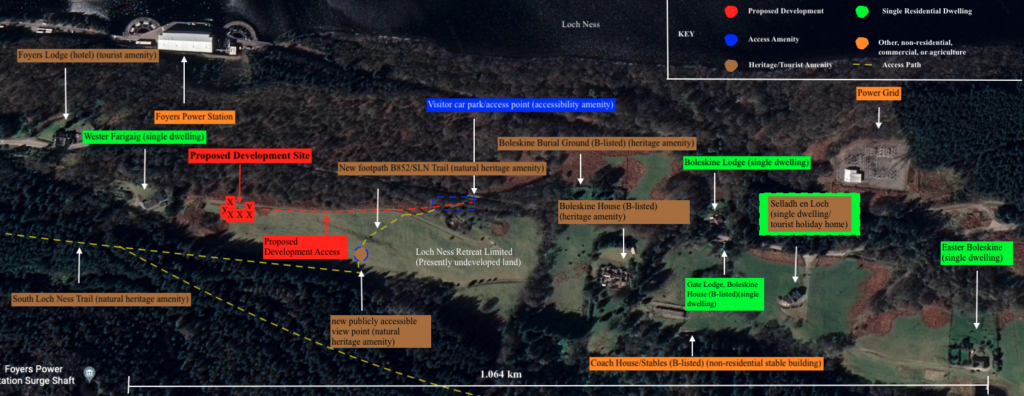
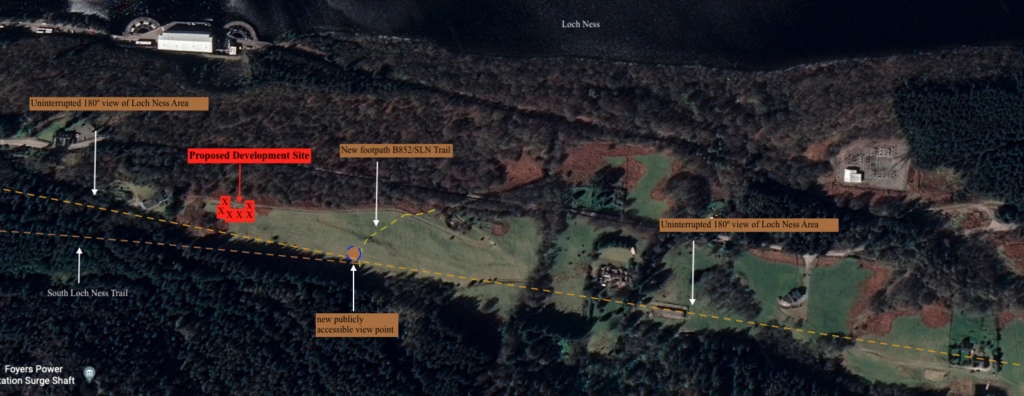
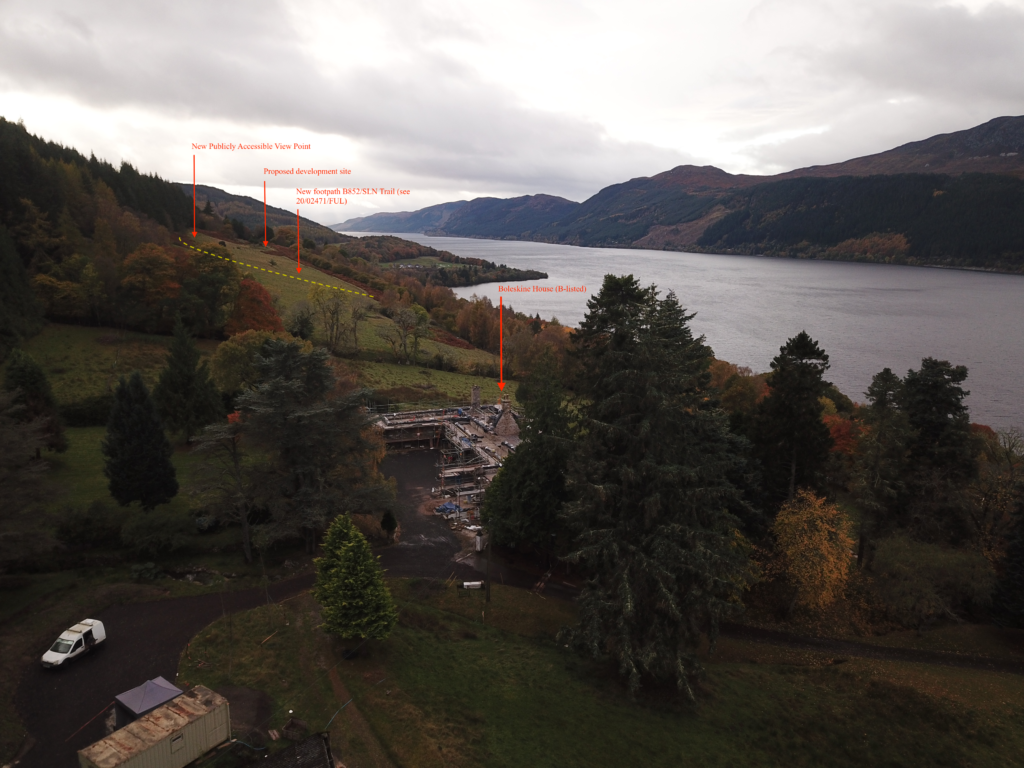
- Impact on Natural, Built and Cultural Heritage (Policy 57): The development will have an adverse and negative impact on the character of the natural and built heritage of the area. The proposal sits 400 meters within direct view of the B-listed Boleskine House and only 150 meters away from a publicly accessible footpath and undisturbed viewpoint of Loch Ness. The applicant has not outlined any mitigation or management of cultural heritage which the Boleskine Estate has put at the heart of its ambition to rebuild and revitalise the estate. The proposal is an obtuse design very nearby several listed sites.
- Impact on species and habitats (Policy 58): The applicant has not undertaken protected species surveys to date. There is no evidence that such a development will not negatively impact protected species included bats, badgers and otter. The applicant has not outlined any mitigation or management of these protected species. The site is in close proximity to Ness Woods SAC (designated for otter, western acidic oak woodland and mixed woodland on base rich soils). The site is in close proximity to Inverfarigaig SSSI (designated for woodland and woodland habitats). Furthermore, orthonology studies have not been undertaken. This proposal has the potential to impact breeding birds, wintering birds, and raptors due to increase collision risk and noise which may lead to translocation and loss of bird diversity in the area.
- Impact on Environment (Policy 64, Policy 65, Policy 66): The site suffers from poor drainage and remains boggy even in the dry months. There is no burn for discharge. There is no evidence that the site will not have problems concerning foul drainage, flooding, or surface water, especially once hard standing is put in place.
- Impact on Public Access (Policy 77, Policy 78): There will be a negative impact on public access due to the applicant’s accessibility in and out of their site via a visitor car park, footpath and tourist information centre.
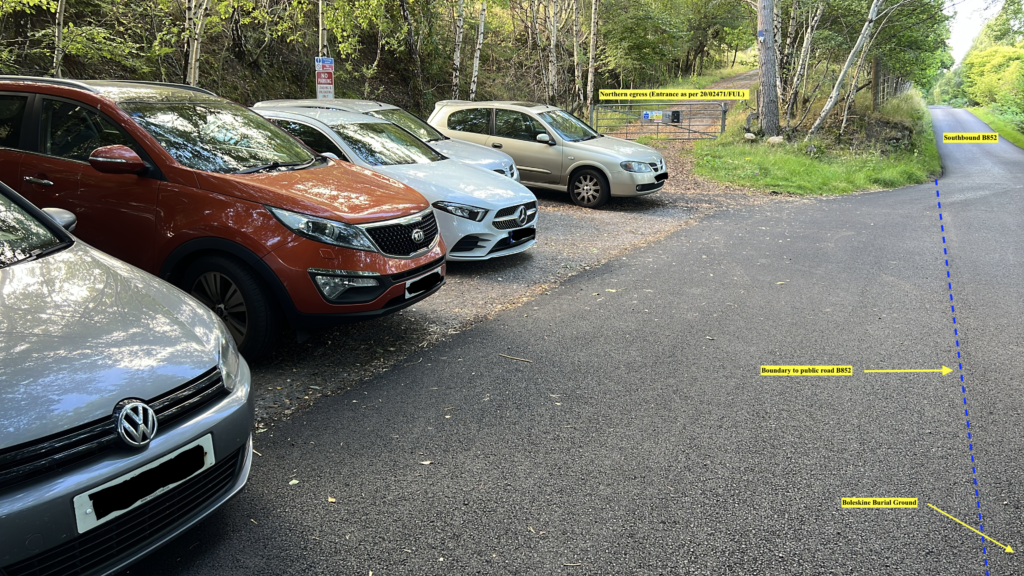
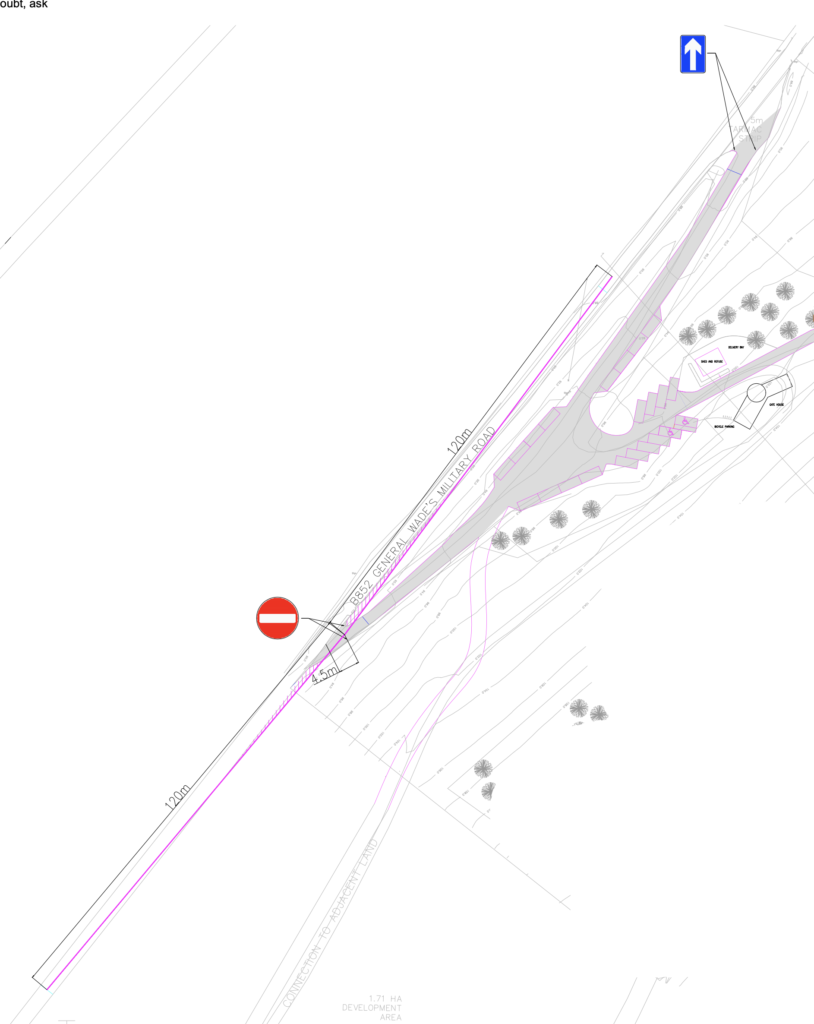
- Inadequate Road Safety, Accessibility and Servicing: The proposals do not specify safe accessibility to and from the site, which is via a public car park and footpath. There are no passing places for cars arriving and departing from the site, and there is not an adequate turn radius for merging onto the B852.
- Archaeology and Historic Environment: The site was historically used to house workers during the construction of the Hydro Board in the 1970s. There may be important information for the historical record and surveys should be carried out.
- Environment and land contamination: With respect to the above point, it is unknown whether land contaminants exist in the ground due to the aforementioned settlements that exists in the twentieth–century. Thorough surveys will need to investigate the potential for hazardous materials which could become airborne with heavy plant over the land during the construction phase
- Construction impact and amenities: Noise receptors during construction have not been considered. A noise receptor includes any non domestic and domestic property in close proximity to construction works. For this planning proposal, this mainly involves local residential properties and schools. It is also not clear where the applicant will source their water to clean vehicles and plant before progressing onto the public and private roads needed to reach their site.
- Waste Management: There is no space available for kerbside collection of household and recycling waste for the development. The applicant does not own the land bordering the public road over which they access their site. The road is too narrow for bins to be placed on the road itself and this would block the free flow of traffic. The applicant has proposed that rubbish is collected 400 meters away, up a steep slope via a visitor car park with one-way traffic and interacting with a public footpath. The only alternative option for the proper disposal of waste is placing bins alongside the burial ground on the B852.
- Inability to signpost: The applicant does not own any part of the access road or the front gates, and has no ability to post signage, likely resulting in logistical problems along the most narrow point of B852.
Residents are encouraged to familiarise themselves with the above points and may consult the official objection letter loged by the Farigaig and Boleskine Residents Association to The Highland Council regarding the plans. Please see pictures and maps below in the next section.
Visual Aids
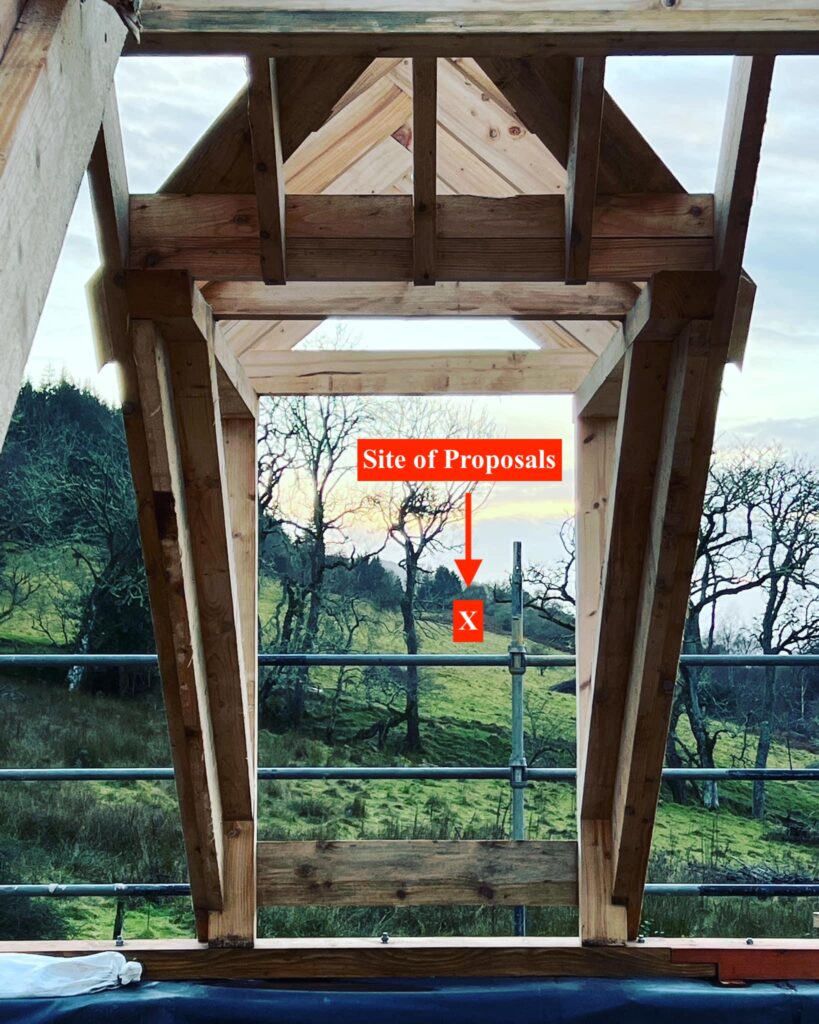
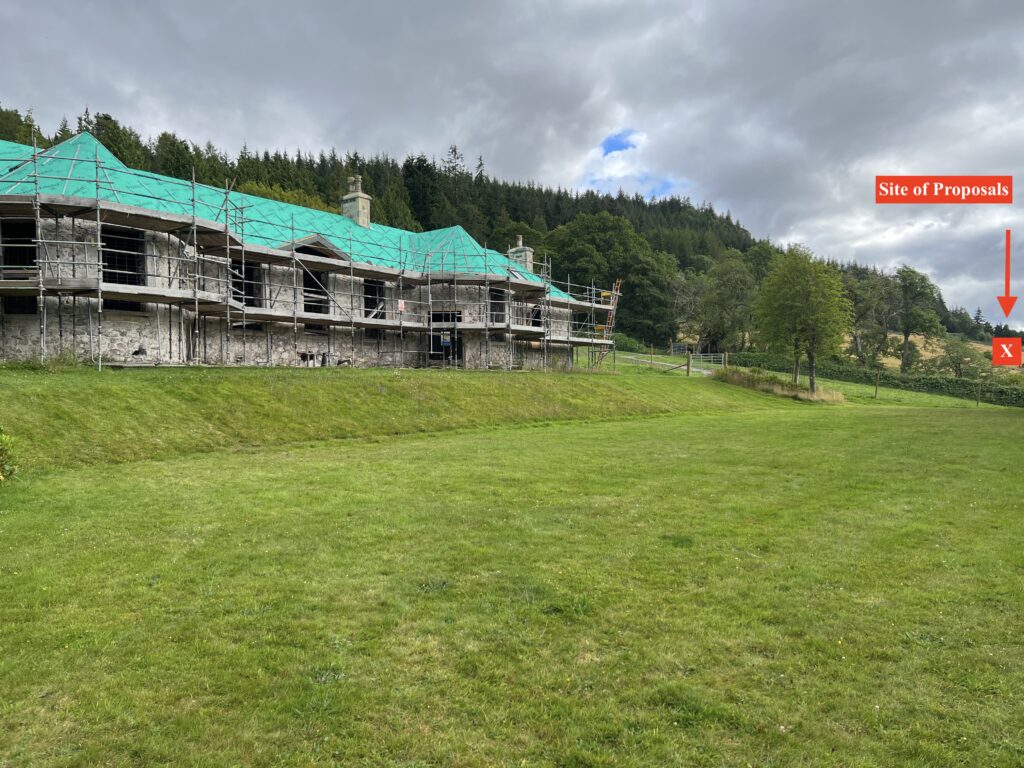
What the proposals mean for local residents
Beyond the material planning considerations outlined above, it is necessary to outline clearly how this affects local residents in the immediate area as well as those travelling along the Boleskine corridor of the B852.
- Change of planning precedents: Granting permission for this application will change the planning precedent and allow for further development of its character to be permitted on the remaining plots of land in the immediate and wider area. Of concern are the plots that surround Selladh en Loch either side between Easter Boleskine and The Gate Lodge, the existing plot between Boleskine Lodge and the Boleskine burial ground and down to Loch Ness (which is owned by the applicant to the current proposals), and lands further along the B852 between the burial ground and Foyers Lodge.
- Visual Impact and the loss of Loch views, natural and built heritage amenities: The undisturbed character and preservation of the landscape of the immediate area is what makes this area an enjoyable place both for residents and tourists supporting our local businesses. The only access for this site is via the entrance-only northern egress for the Boleskine fields. New footpaths connecting the South Loch Ness Trail and a publicly accessible car park for visitors to the Boleskine burial ground and Boleskine House are proposed through this access. In addition the re-wilding wildflower initiative by The Boleskine House Foundation seeks to preserve the natural landscape for the enjoyment by local residents and tourists in the area. The current proposal, and the cars parked at this dwelling will have a high negative impact on the access and views of our natural and built heritage amenities.
- Impact on services: It is not clear how the proposal will access water, which runs behind the site on land owned by the Foresty Commission. There could be disruptions in the water services north of the site, particularly to Boleskine House, Selladh en Loch, and Easter Boleskine. With regard to electrical services, it is not clear whether the current load capacity for the electrical grid can support another large dwelling. Poles do not exist on the land, which again will affect the visual impact of the area with overhead wires being run.
- Impact on roads and the increase risk of road and pedestrian safety: The applicant will have one legal route of access via an entrance-only route at the Boleskine fields. This means that a considerable burden on road and pedestrian safety will likely result. Note also this access is within 20 meters of the Boleskine burial ground, a major tourist attraction. Many of our residents enjoy walks or jogs along this area of the B852. With inappropriate turn radius or visibility splays at the junction of the B852, there will be considerable danger to local residents and tourists travelling by car or by foot.
- Impact of construction: The noise from the works that will ensue could negatively impact local businesses that rely on tourist accomodation. While the impact of construction noise is not a material planning condition, it is material to consider how construction vehicles will further burden and affect the public roads. With limited visibility and turn radii and a possible inability to clean debris off of vehicles before exiting on B852, the is clearly a material consideration for how roads are impacted by this, potentially for many years.
What the proposals mean for residents in the greater Loch Ness area
- Visual Impact and the loss of Loch views, natural and built heritage amenities: It cannot be reinforced enough that the visual impact of the development will affect all who live in and visit the Loch Ness region. The design, if given permission will sit prominently on an exposed area of Loch Ness and within direct sight of Loch Views. The development will be seen from boats on Loch Ness as well as the opposite side along A82. While the current positioning of the development may be slightly obscured by gorse and ferns, there is nothing to protect this foliage from being removed and the the site exposed even further, making an even greater negative visual impact.
What the proposals mean for everyone else internationally
- Visual Impact on natural and built amenities and tourism: Loch Ness is visited by thousands of people from all over the world each year. Visitors come to enjoy the undistrubed landscape that the Highlands has to offer, to walk the trails, enjoy breath-taking views of the natural landscape, and visit local heritage sites. The proposal sits within direct sight not only of the natural heritage and Loch views, but within close proximity to four historically listed sites—Boleskine burial ground, Boleskine House, The Bolesine Coach House, and the Boleskine Gate Lodge. The reader should refer to visual aids on Figures 3, 7, and 8 above.
Contact
It is important to note that the timeous timing period for this application ends on 10 April 2023.
Please lodge a formal comment on the planning application to epc.planning@highland.gov.uk, referencing “23/01280/PIP” in the subject heading. Please provide your name and address to the council or remark that it is to be treated anonymously. Be sure to clearly state that you object (or support) to the proposals and provide material reasons for your letter. You may use any of the above points found under Material Planning Considerations above.
We invite any local resident with questions and request for more information to write to us at farigaig.boleskine.residents@gmail.com.
Additonal Contacts:
We encourage concerned parties to write to the Stratherrick and Foyers Community Council to express their concerns at email.sfcc@aol.com.
Consult your local Councillors for the 12 Aird and Loch Ness Ward and express your concerns: Chris.Ballance.cllr@highland.gov.uk, Helen.Crawford.cllr@highland.gov.uk, David.fraser.cllr@highland.gov.uk, emma.knox.cllr@highland.gov.uk.
